Picture a world where computers filled entire rooms, costing fortunes and accessible only to governments and massive corporations. Then, almost overnight, the digital landscape shifted dramatically. The period we now call the Fourth Generation Era, roughly spanning 1971/1972 to 1990, didn't just shrink computers; it ushered in the "Age of Personal Computing," democratizing technology and fundamentally reshaping how we live, work, and connect. This transformative period is often characterized by one groundbreaking innovation: the microprocessor.
At a Glance: The Fourth Generation Revolution
- Defining Technology: The microprocessor made computers dramatically smaller and more powerful.
- Key Innovation: Very Large Scale Integration (VLSI) packed thousands of components onto a single chip.
- User Experience: Graphical User Interfaces (GUIs) and the mouse made computers user-friendly for the first time.
- Accessibility: Personal computers became affordable for homes, schools, and small businesses.
- New Applications: Word processing, spreadsheets, gaming, and early networking took off.
- Era of Giants: Iconic machines like the Apple II and IBM PC defined personal computing.
The Microprocessor Unleashed: A Giant Leap in Miniaturization
Before the Fourth Generation, computers relied on integrated circuits (ICs) that were powerful but still required significant space. The game-changer arrived in 1971 with Intel's release of the Intel 4004, the first commercially available microprocessor. Imagine an entire Central Processing Unit (CPU) – the computer's "brain" – condensed onto a single silicon chip. This wasn't just a reduction in size; it was an exponential leap in capability.
This single chip innovation meant computers could be made much smaller, significantly more powerful, and, critically, far cheaper to produce. It was the fundamental ingredient that allowed the personal computer as we know it to exist. The secret sauce behind this was Very Large Scale Integration (VLSI). VLSI technology allowed engineers to cram hundreds of thousands, and eventually millions, of transistors and other components onto a single silicon chip. This level of integration didn't just make systems smaller; it made them exponentially more effective, reliable, and energy-efficient. Processing speeds jumped from nanoseconds to picoseconds, and memory storage expanded significantly with semiconductor memory, floppy disks, and hard drives becoming common.
Beyond the Chip: Usability and Connectivity Come of Age
The microprocessor provided the raw power, but it was advancements in how we interacted with computers, and how computers interacted with each other, that truly defined this era.
The Dawn of User-Friendly Interfaces
Prior generations of computers often required specialized programming knowledge to operate, relying on complex command-line interfaces. The Fourth Generation broke this barrier with the advent of Graphical User Interfaces (GUIs). Suddenly, abstract commands were replaced by visual icons, clickable pictures, and the intuitive input of a mouse. Think of the revolutionary Xerox Alto, which showcased this paradigm shift, influencing later successes like Apple's Macintosh. This move from text-based commands to a visual metaphor made computers accessible to a much broader audience, laying the groundwork for the digital literacy we take for granted today.
Sophisticated Software for Everyone
With more powerful processors and user-friendly interfaces, software development exploded. Advanced operating systems like MS-DOS, Apple DOS, and UNIX enabled users to manage their computer's resources more effectively, often supporting early forms of multitasking. But it was the rise of application software that truly brought computers into everyday life:
- Spreadsheets: Programs like VisiCalc (and later Lotus 1-2-3 and Microsoft Excel) revolutionized business, allowing for complex financial modeling and data analysis on a desktop.
- Word Processing: Applications such as WordStar and WordPerfect replaced typewriters, making document creation, editing, and formatting vastly more efficient.
- Games: From text-based adventures to early graphical arcade conversions, video games became a massive driver for computer adoption in homes.
- Databases: Simple database management systems allowed businesses to organize information more effectively.
The First Threads of a Connected World
While the internet as we know it was still decades away from widespread adoption, the Fourth Generation saw the crucial development of early networking technologies. Local Area Networks (LANs) and Ethernet emerged, allowing computers within an office or campus to connect, share data, and utilize shared resources like printers. This was a monumental step, enabling collaborative work and efficient resource management. Crucially, the foundational internet protocols like TCP/IP (Transmission Control Protocol/Internet Protocol) were also developed and began to see limited use, building the backbone for the global network that would eventually emerge.
The Age of Personal Computing: Impact and Accessibility
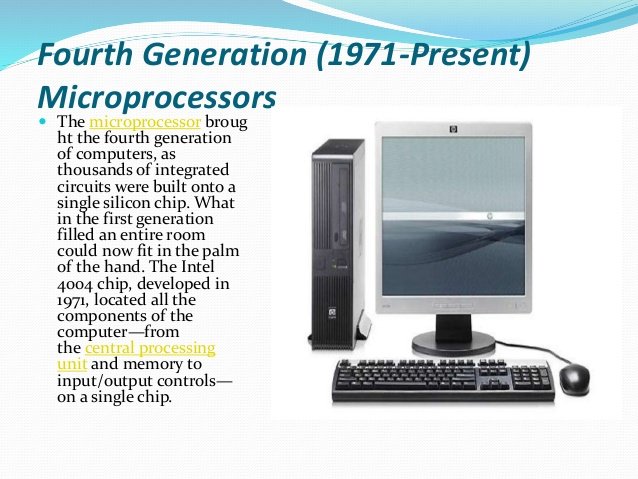
The sum of these technological advancements created an undeniable shift: computers became personal. No longer relegated to climate-controlled rooms, they became microcomputers, fitting comfortably on a desktop or even designed to be portable.
This shift had profound advantages:
- Smaller Footprint: From cabinet-sized machines to desktop wonders, and even early "luggable" portables, computers became manageable.
- Increased Power: Despite their size, they offered significantly more processing power and memory than their predecessors.
- Dramatic Affordability: While still a significant investment, the cost dropped from millions to thousands, making them accessible to small businesses and individuals.
- Enhanced Reliability: With fewer discrete components and better integration, breakdowns became less frequent.
This newfound accessibility led directly to the popularization of personal computing. For the first time, computers found their way into homes for educational games and personal finance, into schools as teaching tools, and into small offices for accounting and document creation. It wasn't just about what computers could do; it was about who could do it.
Real-World Applications: Where the Fourth Gen Shone
The versatility of fourth-generation computers meant they found widespread use across a multitude of sectors, truly embedding computing into society.
- Small Enterprises: Businesses relied on them for vital functions like accounting, inventory management, customer record keeping, and payroll, streamlining operations that once required manual labor or expensive mainframe access.
- Education: Schools adopted microcomputers for computer-based teaching, programming classes, and administrative tasks like student data management. The Commodore PET and Apple II were staples in classrooms.
- Homes: Beyond gaming, families used computers for word processing for school assignments, managing personal budgets, and exploring early educational software.
- Science: Researchers leveraged their increased processing power for complex mathematical operations, running simulation models, and analyzing vast datasets in fields from physics to biology.
- Government: Various agencies utilized these machines for data storage, manipulation, and analysis, improving efficiency in administrative tasks and record-keeping.
- Healthcare: Hospitals and clinics began implementing computers for patient administration, managing medical records, and even assisting with the interpretation of medical imaging, marking the start of digital transformation in medicine.
Iconic Machines That Defined an Era
The Fourth Generation produced a pantheon of computing legends, each playing a crucial role in shaping the industry.
- Apple II (1977): Often credited with popularizing personal computing for the masses, especially with the introduction of VisiCalc, the first spreadsheet program. Its colorful graphics and open architecture made it a hit in homes and schools.
- IBM PC (1981): A monumental release that established the industry standard for business computers. Its open architecture fostered a massive ecosystem of hardware and software developers, leading to the dominance of the "IBM PC compatible" market.
- Compaq Portable (1982): The first 100% IBM-compatible portable computer, allowing users to take their business applications on the go (albeit in a "luggable" form factor).
- Commodore PET (1977): Popular in schools and homes, particularly for its affordability and integrated design.
- TRS-80 (1977): One of the first computers marketed directly to the general public by Tandy Corporation (Radio Shack), making computing accessible through retail stores.
- Xerox Alto (1973): While not commercially successful, this research computer was immensely influential, pioneering many elements of the modern GUI, including the mouse, windows, and icons.
- Osborne 1 (1981): An early, widely popular portable computer, often bundled with essential software like WordStar and SuperCalc.
- Sinclair ZX81 (1981): A remarkably affordable home computer in the UK, it introduced countless individuals to programming and personal computing on a budget.
- Atari 400/800 (1979): Known for their advanced graphics and sound capabilities for the time, these machines were popular choices for gaming and educational software.
The Price of Progress: Affordability in Context
While the Fourth Generation made computers "affordable" compared to their predecessors, it's crucial to understand that they still represented a significant investment for an individual or small business. For instance, an Apple II in 1977 could cost upwards of INR 4,56,500 – 6,22,500 (adjusted to today's terms for perspective), and an IBM PC in 1981 might set you back INR 3,32,000 – 4,98,000. These were not impulse buys; they were carefully considered purchases, often financed, signifying a commitment to the burgeoning digital future. The TRS-80 Model I, at INR 2,07,500 – 2,90,500, was among the more budget-friendly options, but still a substantial sum for the average household.
Comparing Generations: A Leap Forward from the Third
To truly appreciate the Fourth Generation's impact, it's helpful to see how it built upon, and dramatically surpassed, its immediate predecessor. The Third Generation, defined by Integrated Circuits (ICs), brought us the mini-computer and time-sharing operating systems, but the Fourth Generation took that foundational work and miniaturized, personalized, and democratized it.
| Feature | Third Generation | Fourth Generation |
|---|---|---|
| Core Technology | Integrated Circuits (ICs) | Microprocessors, VLSI |
| Size | Mini-computers (room/cabinet) | Microcomputers (desktop) |
| Speed | Nanoseconds | Picoseconds |
| Primary Memory | Magnetic cores | Semiconductor memory |
| OS | Time-sharing OS | Advanced OS with GUI |
| User Interface | Text-based, Command-line | Graphical interfaces with mouse |
| Cost | Affordable for large businesses | Affordable for small businesses/individuals |
| Applications | Business data processing | Personal computing, gaming, word processing |
| Heat | Moderate | Lower |
| This table highlights a dramatic shift in scale, speed, usability, and accessibility. The move from nanoseconds to picoseconds might sound like a small difference, but it represents orders of magnitude in processing power, enabling complex software and faster operations. The transition from magnetic cores to semiconductor memory allowed for faster data access and higher storage densities, further boosting performance. |
Challenges and Compromises of the Era
Despite its revolutionary advancements, the Fourth Generation wasn't without its growing pains and limitations.
- Manufacturing Complexity and Cost: While end-user prices dropped, the production of these highly complex VLSI chips required sophisticated and expensive fabrication plants. This meant high upfront costs for manufacturers, which were then passed on, albeit reduced, to consumers.
- Specialized Knowledge for Development and Maintenance: While GUIs made using computers easier, programming them, troubleshooting issues, or performing maintenance still often demanded specialized knowledge. The "IT professional" role began to solidify during this period.
- Emerging Security Risks: As computers started connecting to networks, even rudimentary ones, new vulnerabilities emerged. The concept of "hacking" began to enter the public consciousness, with networked systems opening doors for unauthorized access and data manipulation, foreshadowing the immense cybersecurity challenges of later generations.
The Enduring Legacy: Laying the Groundwork for Today's Digital World
The Fourth Generation wasn't just a stepping stone; it was a launchpad. The innovations of this era created the blueprint for nearly every aspect of modern computing. Without the microprocessor and VLSI, laptops wouldn't exist. The development of GUIs directly paved the way for the intuitive operating systems we use daily on our PCs, smartphones, and tablets. The nascent networking protocols and local area networks of this time were the fundamental building blocks for the global internet that now connects billions.
The idea that a computer could be a personal tool, a device for individual empowerment and creativity, was born in this period. It shifted computers from calculating machines to communication hubs, from business tools to entertainment centers. If you’re curious to understand more about the subsequent developments and how technology has evolved, you can Explore 4th generation and beyond in our comprehensive series. The Fourth Generation laid the essential foundation, demonstrating that technology's true power lies in its accessibility and ability to integrate seamlessly into human lives.
Looking Back, Moving Forward
The Fourth Generation of computing wasn't merely an incremental update; it was a paradigm shift. It took computing out of the sterile lab and into the bustling office, the quiet classroom, and the family living room. By making computers smaller, faster, cheaper, and fundamentally easier to use, this era ignited the personal computing revolution. Every time you click an icon, open a spreadsheet, or connect to a network, you're experiencing the direct legacy of the ingenious engineers and visionary leaders who defined the Fourth Generation Era. They didn't just build better machines; they built the foundation for our digital future.